
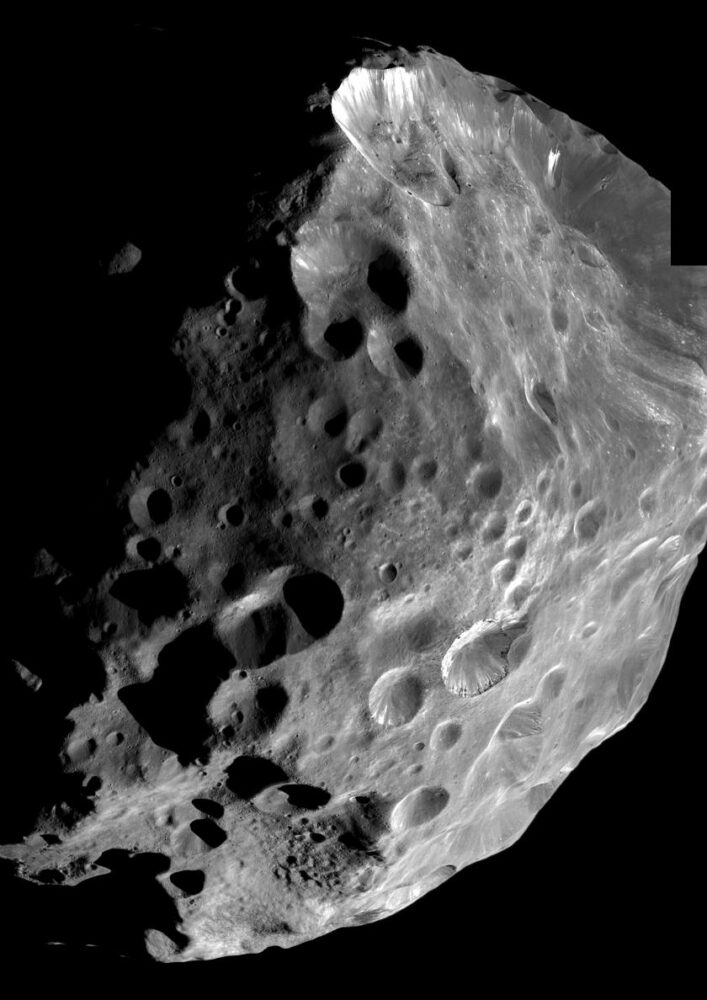
This mosaic of six images from the Cassini flyby of Phoebe showcases the irregular topography and plentiful craters. Credit: NASA/JPL/Space Science Institute

Key Takeaways:
- William Pickering discovered Phoebe, a moon of Saturn, in March 1899, based on photographic plates from August 1898.
- Phoebe's discovery marked the first instance of a moon being discovered photographically.
- At the time of its discovery, Phoebe was considered Saturn's outermost moon, though this is now known to be inaccurate.
- Phoebe's irregular orbit, confirmed by the 2004 Cassini flyby, suggests it is a captured object.
In March of 1899, William Pickering discovered Phoebe, a moon of Saturn, on photographic plates taken on Aug. 16, 1898, by DeLisle Stewart. It was the first moon to be discovered photographically, rather than observationally, and over a hundred years later, it would be the first target of the Cassini spacecraft. Phoebe orbits at a considerable distance from Saturn (about 8 million miles [nearly 13 million kilometers]), far enough that when it was discovered it was believed to be Saturn’s outermost moon. (Today we know there are several smaller moons further out.) Phoebe also has a highly irregular orbit, suggesting it’s a captured object, and observations during the 2004 Cassini flyby bore that out.